Saturday, 28 February 2009
Virtue
'Augustine teaches us: the greatest part of virtue lies in the absence of opportunity for vice ...' Strip this down and it reveals an ethics based wholly upon happenstance. Cool, or what?

Friday, 27 February 2009
The Wealth of Nations
Smith's The Wealth of Nations always strikes me as a title that's been prematurely truncated. In some more truly prophetic alternate reality Smith wrote: An Inquiry into the Nature and Causes of the Wealth of Nations and How it Dissolves the Very Category of Nation.
Thursday, 26 February 2009
Wednesday, 25 February 2009
Says the reader
“I read to be shocked”—“wonderful! Because I want to shock you!” This is the wrong reply, of course; like the gag about the masochist asking the sadist to whip him an the sadist replying—“no!” A better answer would be: “but what you think will shock you, an excess of stimulation (as it might be, sex, violence, the abject) won’t actually. You are not aware of what will really shock you …”
Tuesday, 24 February 2009
On writing
Sometimes I read things that pierce me, like a sharpened pencil straight through the heart, in instant recognition. Here’s Hermione Lee on Katherine Anne Porter (LRB 12 Feb 09): “Like Lawrence, who she read with critical attention, she seemed not always to have known whether what she was doing was good or not, but to have written because she felt she had to."
Monday, 23 February 2009
Where is my mind?
Jerry Fodor's ‘Where is my mind?’ reviews Andy Clark’s Supersizing the Mind: Embodiment, Action and Cognitive Extension, and really doesn’t like the thesis … broadly, that our minds extend into the world around us, and aren’t just contained in our heads. The view that, as David Chalmers puts it:
I bought an iPhone. The iPhone has already taken over some of the central functions of my brain … The iPhone is part of my mind already … [Clark’s book] defends the thesis that, in at last some of these cases the world is not serving as a mere instrument for the mind. Rather, the relevant parts of the world have become parts of my mind. My iPhone is not my tool, or at least it is not wholly my tool. Parts of it have become parts of me … When parts of the environment are coupled to the brain in the right way, they become parts of the mind.Seems a reasonable case to me. But Fodor doesn’t like it. He takes a heuristic trot through one of Clark’s thought-experiments concerning Otto and Inga ‘both of whom want to go to the museum. Inga remembers where it is and goes there; Otto has a notebook in which he has recorded the museum’s address. He consults the notebook, finds the address and then goes on his way. The suggestion is that there is no principled objection between the two cases: Otto’s notebook is (or may come with practice to serve as) an “external memory”, literally a “part of his mind” that resides outside his body.’ Fodor asks himself: ‘so could it be literally true that Chalmer’s iPhone and Otto’s notebook are parts of their respective minds?’ He answers, no. But I don’t take the force of his objections. So for instance:
[Clark’s] argument is that, barring a principled reason for distinguishing between what Otto keeps in his notebook and what Inga keeps in her head, there’s a slippery slope from one to another ... That being so, it is mere prejudice to deny that Otto’s notebook is part of his mind if one grants that Inga’s memories are part of hers. That being Clark’s argument, the parity principle doesn’t come into it; which, as we’ve been seeing, is probably just as well. But it does bear emphasis that slippery-slope arguments are notoriously invalid. There is, for example, a slippery slope from being poor to being rich; it doesn’t follow that whoever is the one is therefore the other, or that to insist on the distinction is mere prejudice. Similarly, there is a slippery slope between being just a foetus and being a person; it doesn’t follow that foetuses are persons, or that to abort a foetus is to commit a homicide.But this really is to miss the point. The analogy (since Fodor forces it) is not that Clark is arguing the brain is ‘rich’ and the notebook ‘poor’ and that these are the precisely the same thing; but rather that they both have something in common—as ‘rich’ and ‘poor’ have money in common—the difference being only that one, the brain, has lots of this (call it ‘mind’) and the other, the notebook, has very little. That seems fair enough to me. Fodor goes on to deliver what he takes to be a knockout blow:
The mark of the mental is its intensionality (with an ‘s’); that’s to say that mental states have content; they are typically about things. And (with caveats presently to be considered) only what is mental has content.But lots of the data on my computer is ‘about’ things; indeed, arguably, the arrangement of petals on a flower is ‘about’ something (it’s about how lovely the nectar is inside; it’s about attracting insects). Fodor is surprised Clarke doesn’t deal with intensionality, but let’s say it’s a red herring and move on.
Surely it’s not that Inga remembers that she remembers the address of the museum and, having consulted her memory of her memory then consults the memory she remembers having, and thus ends up at the museum. The worry isn’t that that story is on the complicated side; it’s that it threatens regress. It’s untendentious that Otto’s consulting ‘outside’ memories presupposes his having inside memories. But, on pain of regress, Inga’s consulting inside memories about where the museum is can’t require her first to consult other inside memories about whether she remembers where the museum is. That story won’t fly; it can’t even get off the ground.Fodor, on the evidence of this, has never heard of a mnemonic? Surely not. Or is he denying that the mnemonics I have in my mind are, somehow, not in my mind ‘on pain of infinite regress’?
Sunday, 22 February 2009
Papersmoke
Look at this contemporary woodcut:
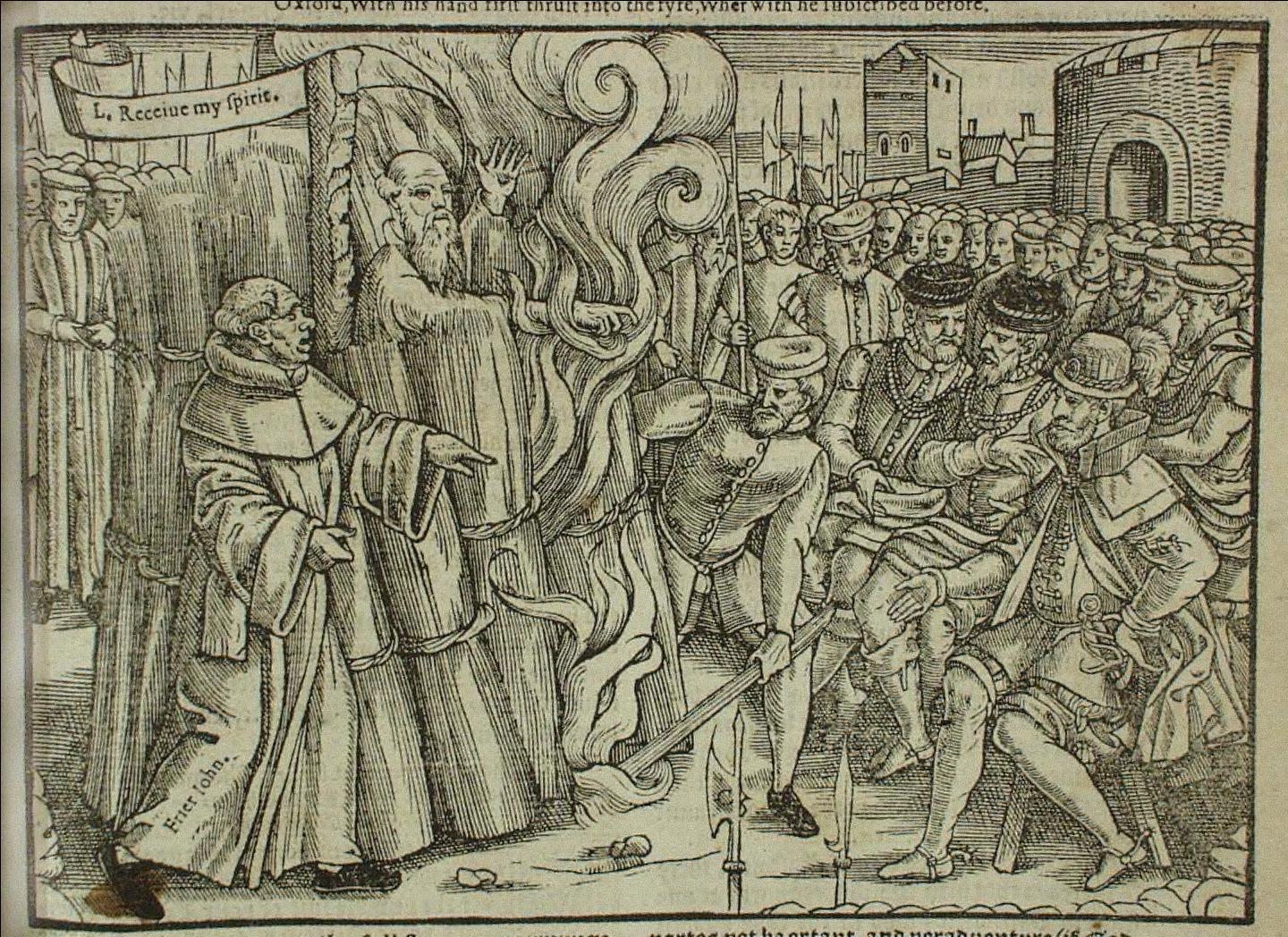
There goes Cramner, in a puff (in a series of roils) of smoke. Doesn't 'Frier John' look like an ugly customer, rushing in from stage left with his pudgy blob-disfigured head? But those aristocratic men in the front row of the seated audience ... surely they can't be baddies? And doesn't that scroll, unrolling from the martyr's mouth ('Lord receiue my fpirit') look lovely? The roils of smoke are drawn to resemble it, I'd say, as if Cramner is being martyred not by fire and smoke but by paper and the word. And the folds of cloth on the three seated gentlemen is part of the same visual logic (look at the sword hilt of the one nearest us: it looketh as if it be wreathed around by the sacred papersmoke).
Papersmoke might be a way of saying; 'fire cannot hurt the true servant of God; he is wrapped in curling paper, like a precious object, on his way to heaven.' But it might also be a way of saying: paper? Words? Even holy paper and words? It is as smoke. Everything, including the grace of God, is a transient thing, and burns.
There goes Cramner, in a puff (in a series of roils) of smoke. Doesn't 'Frier John' look like an ugly customer, rushing in from stage left with his pudgy blob-disfigured head? But those aristocratic men in the front row of the seated audience ... surely they can't be baddies? And doesn't that scroll, unrolling from the martyr's mouth ('Lord receiue my fpirit') look lovely? The roils of smoke are drawn to resemble it, I'd say, as if Cramner is being martyred not by fire and smoke but by paper and the word. And the folds of cloth on the three seated gentlemen is part of the same visual logic (look at the sword hilt of the one nearest us: it looketh as if it be wreathed around by the sacred papersmoke).
Papersmoke might be a way of saying; 'fire cannot hurt the true servant of God; he is wrapped in curling paper, like a precious object, on his way to heaven.' But it might also be a way of saying: paper? Words? Even holy paper and words? It is as smoke. Everything, including the grace of God, is a transient thing, and burns.
Subscribe to:
Posts (Atom)