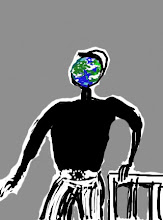
Traffic beaten black and blue.
This tarpaulin sky. This tongue-red
pillar box in amongst the grey.
Wednesday, 31 January 2007

Tuesday, 30 January 2007
Probability
Darwin gets the popular-culture credit for slaying the serpent, or at least for unsettling the grounds for belief in God. But if the Intelligent Design kerfuffle shows anything it's that Darwinism only needs to be bent a very little way out of shape for it to become not only compatible with, but actively supportive of, religious dogma. Wouldn't a better hero figure be the equally bearded John Venn? For much more corrosive of the metallic supports of religious belief is a proper understanding of frequency probability. Or to put it another way; if God does not play dice, and if it turns out that the cosmos does play dice, actually; then the only logical conclusion is ...
Monday, 29 January 2007
The water-surface dwellers
Life developed in the water in the forms both of grazers and predators-upon-grazers. When life developed on land, it took the form of both plant-eating and planteating-eating creatures. In the air there are birds that eat insects, and there are hawks and kites that eat birds-that-eat-insects. We might say, indeed, that wherever life evolves it takes this form of beast and predator.
It's true also of liminal places: the beach, half-land, half-sea; the treetops, half-land-half air, both territories with their specific inhabitants and specific predators. But, wait: what about the surface of the water? That interface between water and air? All those ducks and swans and geese ... why is there no hawk-swan, or falcon-duck? Why, of all the animals adapted for life on the surface of the water, are none of them predators? What makes that environment so special?
It's true also of liminal places: the beach, half-land, half-sea; the treetops, half-land-half air, both territories with their specific inhabitants and specific predators. But, wait: what about the surface of the water? That interface between water and air? All those ducks and swans and geese ... why is there no hawk-swan, or falcon-duck? Why, of all the animals adapted for life on the surface of the water, are none of them predators? What makes that environment so special?
Sunday, 28 January 2007
Why is there something rather than nothing?
It's always seemed to me that this philosophical chesnut isn't a wff. For to ask 'Why is there something rather than nothing?' presupposes that there is, actually, something rather than nothing. In fact, if we're going to pose a question with two terms ('something', 'nothing') then we have to ready ourselves for the inevitable two-by-two matrix:
Now in two of these cases (the first and third) the somethingness of something clearly trumps the nothingness of nothing; or to put it another way: what would the cosmos look like if there were something rather than nothing? [answer: pretty much as it does now.] And what would the cosmos look like if there were both something and nothing? [answer: pretty much as it does now]. And four reveals two in its true light; not as the exclusion of something, but as the dialectical balance of nothingness (ground) and somethingness (relief), which leads back to the same question-and-answer. what would the cosmos look like if there were nothing rather than something? [answer: pretty much as it does now]
The only question that does not lead us to the cosmos pretty much as it is now is four. And this is a problem. But it is a differently weighted problem than the one implied in the usual formulation of the question: not a 50-50 mystery 'something? nothing?' (which balances ontologically on the knife-edge) but a 75-25 split, weighted heavily on the former term, 'something'. Which in turn suggests one possible answer to the question.
But how satisfying an answer is that?
Why is there something rather than nothing?
Why is there nothing rather than something?
Why is there both something and nothing?
Why is there neither something nor nothing?
Now in two of these cases (the first and third) the somethingness of something clearly trumps the nothingness of nothing; or to put it another way: what would the cosmos look like if there were something rather than nothing? [answer: pretty much as it does now.] And what would the cosmos look like if there were both something and nothing? [answer: pretty much as it does now]. And four reveals two in its true light; not as the exclusion of something, but as the dialectical balance of nothingness (ground) and somethingness (relief), which leads back to the same question-and-answer. what would the cosmos look like if there were nothing rather than something? [answer: pretty much as it does now]
The only question that does not lead us to the cosmos pretty much as it is now is four. And this is a problem. But it is a differently weighted problem than the one implied in the usual formulation of the question: not a 50-50 mystery 'something? nothing?' (which balances ontologically on the knife-edge) but a 75-25 split, weighted heavily on the former term, 'something'. Which in turn suggests one possible answer to the question.
Q: Why is there something rather than nothing?
A: Well, it's not a necessary state of affairs, but it is the more probable one (three times as probable as the alternative). Therefore, as water runs downhill, the cosmos just happened to slide into the probability declivity and here we are.
But how satisfying an answer is that?
Saturday, 27 January 2007
L'Oedipe de Goux
"Oedipus before the Sphinx. In the confrontation between the obscure monster who poses riddles and the person who victoriously replies “man” we have the condensation of a decisive historical step, a threshold of thought, a turning point of the spirit. Man is finally at the centre. That is why Hegel made this mythic episode the primitive scene of philosophy." Jean-Joseph Goux, Oedipus, Philosopher, p.163
Fair enough, we might say. But then again: the actual Sphinx, the cosmos, asks no questions of man. The actual Sphinx is perfectly indifferent to us. The only being that asks questions of man is man; and when we think of the cosmos as a questioning entity (‘what is my universal law of gravitation? What is my dark matter? What is my end and origin?') we are of course only projecting ourselves, gassy and vague, upon the enormous screen of uncaring materiality. In effect there is no ‘between’ for the Sphinx and man. There is only man. Man is not so much 'finally at the centre', as finally the centre, margins and everything else too. It would be better to say not Oedipus, philosopher, but Oedipus, solipsizer.
Fair enough, we might say. But then again: the actual Sphinx, the cosmos, asks no questions of man. The actual Sphinx is perfectly indifferent to us. The only being that asks questions of man is man; and when we think of the cosmos as a questioning entity (‘what is my universal law of gravitation? What is my dark matter? What is my end and origin?') we are of course only projecting ourselves, gassy and vague, upon the enormous screen of uncaring materiality. In effect there is no ‘between’ for the Sphinx and man. There is only man. Man is not so much 'finally at the centre', as finally the centre, margins and everything else too. It would be better to say not Oedipus, philosopher, but Oedipus, solipsizer.
Friday, 26 January 2007
Preferring animals to people
This is supposed to be a peculiarly English trait, but I do wonder. There are any number of horse-loving men called Philip and women called Philippa, but I don't know anybody called Philander or Philgynos. Indeed 'philander', as a word rather than a name, has only negative connotations ...
Thursday, 25 January 2007
North wind poem
North wind hisses on
the water, silk-on-silk,
airborne promises
men and women,
of light going her to him
passing on to
where the north wind
hisses colder blue.
the water, silk-on-silk,
airborne promises
men and women,
of light going her to him
passing on to
where the north wind
hisses colder blue.
Subscribe to:
Posts (Atom)