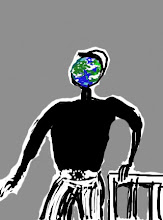
'It would be possible to describe everything Scientifically,' Einstein once said [quoted here, p.32] 'but it would make no sense; it would be without meaning, as if you described a Beethoven symphony as a variation in wave pressure.'
But the senselessness here isn't in the description (after all, a Beethoven symphony is a variation in wave pressure) but in our lacking the capacity to translate that description into a somatic apprehension. Translating the sounds of that symphony into msuical script is only senseless for the person who can't read music; for the person who can it is intensely senseful. Variations in wave pressure is the same thing.
Monday, 14 July 2008

Sunday, 13 July 2008
On watching Scorcese's Last Temptation of Christ
For much of the film I found myself (in a good way) thinking of Deckard's words: 'how can it not know what it is?' The more I think about that question, the more profound and spiritual it seems to me.
The news on the BBC earlier this week was about the Church of England ordaining female bishops, and those members of the Church so outraged by this decision that they are planning to leave. At root (since none of those upset could be coaxed into saying but women are inferior to men!) their outrage was based upon: but this is not what I am used to! To say that something violates tradition is always, at root, to denigrate it because it's not what we're used to. And part of me thinks, fair enough: continuity and tradition and important props to help human subjectivity along its torturous path. But it also makes me want to say to one of these anti-female-bishop Anglicans: have you even read the New Testament? It's a text open to a number of interpretations of course, but one thing that comes unambiguously out of it is the message: everything is different now. It is a book that says, in its whole as well as in numerous specific places: give up your attachments to the old ways, however comforting you find them. It's all new. To live according to the logic of the Gospels, surely, must be to live as thoroughly as you can the everythingness and the difference and the nowness of everything is different now.
The news on the BBC earlier this week was about the Church of England ordaining female bishops, and those members of the Church so outraged by this decision that they are planning to leave. At root (since none of those upset could be coaxed into saying but women are inferior to men!) their outrage was based upon: but this is not what I am used to! To say that something violates tradition is always, at root, to denigrate it because it's not what we're used to. And part of me thinks, fair enough: continuity and tradition and important props to help human subjectivity along its torturous path. But it also makes me want to say to one of these anti-female-bishop Anglicans: have you even read the New Testament? It's a text open to a number of interpretations of course, but one thing that comes unambiguously out of it is the message: everything is different now. It is a book that says, in its whole as well as in numerous specific places: give up your attachments to the old ways, however comforting you find them. It's all new. To live according to the logic of the Gospels, surely, must be to live as thoroughly as you can the everythingness and the difference and the nowness of everything is different now.
Saturday, 12 July 2008
Industrial Revolution
There's the chance I should have made more of that portion of the iceberg that necessarily lies below the waterline visible. For instance, an 1848 shaped by the discovery and exploitation of both Liliputians and Brobdingnagians. What might such an 1848 be like? Would it be an 1848 still rooted, for the most part, in late 18th-century? Or would it be more like 1914?
"Actually that is something else that bothers me about the book. Why did he very deliberately choose 1848, the year of revolutions? The Franco-British war (what pitifully small portion of it we glimpse) bears more relationship to Napoleonic era warfare nearly half a century earlier. "
Or: Liliputians might be exploited to make smaller and more intricate machines; but in a C19th context such machines are really just toys. On the other hand, Brobdingnagians would be used to do the super-heavy lifting, and for that reason the big machines of the C19th industrial revolution need not be invented. Since it is the big machines that made the industrial revolution happen, this would surely have an effect of stagnating technological advance. It's different now, of course: although culture is often strangely enamoured of enormities of scale, in fact the late 20th-century technological revolution was all about miniaturisation (about the Lillis, not the Brobs).
Friday, 11 July 2008
Thursday, 10 July 2008
Genesis
The first two human tales in Genesis, that of Adam and Eve and that of Noah, are clearly making points about the virtue of obedience. But the book as a whole then moves from synthesis to antithesis; the stories of Abram, Lot and Abraham and Isaac equally clearly make points about the necessity of disobedience, or more specifically the need to temper obedience with disobedience. Blind obedience is a terrible thing; absolute loyalty is incompatible with free will; authority is to be respected only insofar as it does not become arbitrary tyranny. The moral of the story of Abraham and Isaac is the same moral as the story of Adam and Eve, which is to say, in both cases the protagonists act the wrong way. Just as it was wrong for Adam to blight his descendents by disobeying God, it was—patently—wrong for Abraham to make such a fetish of obedience to a cruel, arbitrary and tyrannous command as that of God in Genesis. To too great a degree, religions descended from this book have learnt the first of these lessons but not the second.
Wednesday, 9 July 2008
Lip service.
Lip-service--as opposed to, what? Genuine service ... 'troth', as it used to be called? But troth in which nothing is said: nothing promised, sworn, communicated? That sounds much worse. What can a poet, or a kiss, offer except lip service?
Tuesday, 8 July 2008
Watches
I've a fanciful notion that we strap time onto our wrists not so much because it's nicely accessible for our eyes, but because subconsciously we like the idea of time dangling in the region of our hips. Our hips are the true benchmark of time, because the fruit thereof, children, are its true scale.
Subscribe to:
Posts (Atom)