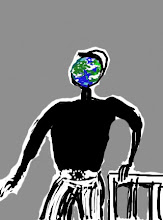
This is a line of thought that 'atheism', though wishing to define itself as independent of God, is inevitably already defined in reference to God, and is therefore a sort of subset of religious belief. You can see why the logic appeals. But to say 'atheism is something always already grounded in theism' is to work with the presupposition that God is the ground, and the other quantity is always thrown into relief by that ground. The problem here is that the opposite argument has exactly as much legitimacy. In other words we could argue that godlessness in the ground -- let's say, the whole empty, rainy, stony Earth into which early man came into consciousness -- and religion, prophylactic against angsty nihilism and despair, is always thrown into relief against that ground. That atheism, in other words, is prior. So, not that secularism is a religion, but religion is another kind of seculairsm. That theism is another kind of atheism.
That's not to say that there's a way of deciding which of these, ying, yang, is the right way of looking at things, of course.
Thursday, 21 December 2006

Wednesday, 20 December 2006
The image
There is room for the image in the eversplendid place. For certain kinds of image, at any rate.
Tuesday, 19 December 2006
Modern Times
One of the symptoms of modern times is the way that love as a general quantity has become so thoroughly personalised and sexualised. It’s about me and the person I want to fuck. It’s there to fulfil me, and it finds expression in my fucking, because that enables passion, excitement, danger, piquancy, ego-reinforcement and sexual pleasure. It’s, frankly, hard to beat. Most of us would of course acknowledge that family-love is also an important part of life: but it is something that seems to have been very sharply separated out from the eros-love. This leads to a number of awkwardnesses—for most of us come to sexual maturity within families, and therefore find ourselves experiencing the sometimes uncomfortable frictions of different and incompatible modalities of loving at work upon us. Best get the hell out of there, maybe: find yourself a girlfriend/boyfriend, find your own space and get down to it. These are the times we find ourselves filled with a disproportionate and rather nameless dread at the prospect of our own parents having sex (ugh! I don’t want to think about it!) On a cultural level, and lancing more sharply into the tender spots of the collective psyche, a mass hysteria has accumulated around the distressing subject of child-abuse. Sex and the family become increasingly so immiscible as to begin actively threatening one another. This really is not a healthy state of affairs.
‘Love has been personalised and sexualised in the past 200 years, and that process has been in part responsible for cutting the ties which bind individuals to a social sense, and an understanding (and acceptance) of her or his part in society. When we started to think of love in terms of romance, of sexual desire, and above all of a lifelong entitlement to both experiences, then we effectively turned away from engagement with the intimately social question of the impact of our actions upon others. Thus we can (and obviously do) theorize extensively about the ‘breakdown’ of the family and the rise of the single-person society, but until we address the beliefs that motivate and inspire these changes we examine only the consequences rather than the causes’ [Mary Evans, Love: an Unromantic Discussion (Polity 2006), 123]
‘Love has been personalised and sexualised in the past 200 years, and that process has been in part responsible for cutting the ties which bind individuals to a social sense, and an understanding (and acceptance) of her or his part in society. When we started to think of love in terms of romance, of sexual desire, and above all of a lifelong entitlement to both experiences, then we effectively turned away from engagement with the intimately social question of the impact of our actions upon others. Thus we can (and obviously do) theorize extensively about the ‘breakdown’ of the family and the rise of the single-person society, but until we address the beliefs that motivate and inspire these changes we examine only the consequences rather than the causes’ [Mary Evans, Love: an Unromantic Discussion (Polity 2006), 123]
Monday, 18 December 2006
On Tony Blair
The gag, famously, is: ‘the great thing is sincerity; if you can fake that, you’ve got it made’. But it’s easier said than done. There’s a trick, and I’ll tell you what it is: you must, knowing yourself to be insincere, nevertheless believe in your own sincerity. Now, the problem in putting it like that is in suggesting a diremption between ‘knowledge’ and ‘belief’, and that’s not the trick. I might with equal accuracy say, ‘you must, believing yourself to be insincere, nevertheless know that you are sincere.’ The trick is that this sincerity is rooted not in the content of what the person says, nor in the manner of the saying, nor the intentions of the person saying it. Sincerity becomes a universal category into which you tap regardless of your localised pragmatic deceitfulness. It’s not a task for the actor, even the method actor; nor is it something that can be accomplished by the self-deluder, or the non-believer. It is a rare and very valuable social ability that only a few possess. They often go far with it.
Sunday, 17 December 2006
Fathers and daughters
A daughter will redeem a father, assuming he's capable of being redeemed. That's the difference between daughters and sons.
Saturday, 16 December 2006
Two summer poems (for midwinter)
:1:
Migraine weather, ninety,
or ninety-nine.
Blipping poplars
barcode a road
straight as rail, or
a thermometer line.
:2:
Four dogs, down, tongues
like untucked shirtstails.
Mud, or Assyrian concrete,
preserving the hook-prints
of its many past horses,
all facing in different directions.
Migraine weather, ninety,
or ninety-nine.
Blipping poplars
barcode a road
straight as rail, or
a thermometer line.
:2:
Four dogs, down, tongues
like untucked shirtstails.
Mud, or Assyrian concrete,
preserving the hook-prints
of its many past horses,
all facing in different directions.
Friday, 15 December 2006
Air
There has been an act of what amounts to collective forgetting about air. Air has become a sort of vacuum—a strange paradox. There is, it seems, no air between us and the distant hills turning them blue; it is the hills themselves that are blue, or so we have fallen into the habit of thinking.
And yet air is the most intimate part of the natural world. It interpenetrates us; it is that part of the external world that most fully invades us. This air that circles the globe is also a component of my body, as essential and as internalised as my bones, my spleen, my heart. The sky over France is a huge extension of a part of my body that is rooted next to my heart. Air, in other words, is the only one of my body’s organs that is both common and ubiquitous. People on the other side of the planet are internalising my organ, as I theirs. The blowing of the winds is the most communal, orgiastic and deep-throated of blow-jobs.
Our thoughts about air see it as a medium, as the neutral and invisible solvent by which everything else is carried: sound waves travel in air (as if sound waves could be separated out from air! Say rather that sound waves are air); pollution is ‘air-borne’, as if air is the pure white packhorse and ‘pollution’ is the dirty sack of coals across its saddleback. This sort of thinking doesn’t help us. Pollution, in fact, is simply one of the manifestations of air. Thinkers who have long since chased away the superstitious old habit of thinking in terms of ‘appearance and reality’, of ‘phenomenal and noumenal’, of ‘truth and representation’ still assume this structure of thought with respect to the air they breathe. Freeing this sort of thinking from ‘air’ will open the windows.
So, for example, if we talk of ‘clouds existing in the air’, it implies that they might exist outside the air. But clouds are air, another one of its many protean forms.
To be more specific on this question: by talking of ‘the five senses’ we tend to hypostise the sensed material; so ‘a sense of smell’ implies that there is a material substance out there called ‘smell’ that our sense apprehends. This is not quite the case. ‘Scent’ is not some pure, ideal quantity that is carried ‘on the air’; it is, once again, one of the many forms of air. Similarly, sound waves can no more be separated from the air than ocean-waves can from the ocean. What would a ‘pure’ ocean-wave look like, the isolated ‘content’ separated from the ‘form’ of the sea? Perhaps we are tempted to think the answer to that question in terms of ‘information’, but that doesn’t get us any further, because information is always already embodied in one or other material form. There’s no such thing as ‘pure’ information.
Our sense of taste is closely bound up with our sense of smell; and the nerve-endings that mediate our sense of touch are fine-tuned for operation in air (although, of course, it is possible to feel pressure and temperature without air; but that's the crudest manifestation of the sense). This is to say: air shapes four of our senses. Only sight is exceptional, and it is so in interesting ways. So: the lunar astronaut only hears, only smells and tastes, only feels by virtue of the envelope of air inside his or her spacesuit, but he or she can see the stars without air. From this follow several interesting consequences.
And yet air is the most intimate part of the natural world. It interpenetrates us; it is that part of the external world that most fully invades us. This air that circles the globe is also a component of my body, as essential and as internalised as my bones, my spleen, my heart. The sky over France is a huge extension of a part of my body that is rooted next to my heart. Air, in other words, is the only one of my body’s organs that is both common and ubiquitous. People on the other side of the planet are internalising my organ, as I theirs. The blowing of the winds is the most communal, orgiastic and deep-throated of blow-jobs.
Our thoughts about air see it as a medium, as the neutral and invisible solvent by which everything else is carried: sound waves travel in air (as if sound waves could be separated out from air! Say rather that sound waves are air); pollution is ‘air-borne’, as if air is the pure white packhorse and ‘pollution’ is the dirty sack of coals across its saddleback. This sort of thinking doesn’t help us. Pollution, in fact, is simply one of the manifestations of air. Thinkers who have long since chased away the superstitious old habit of thinking in terms of ‘appearance and reality’, of ‘phenomenal and noumenal’, of ‘truth and representation’ still assume this structure of thought with respect to the air they breathe. Freeing this sort of thinking from ‘air’ will open the windows.
So, for example, if we talk of ‘clouds existing in the air’, it implies that they might exist outside the air. But clouds are air, another one of its many protean forms.
To be more specific on this question: by talking of ‘the five senses’ we tend to hypostise the sensed material; so ‘a sense of smell’ implies that there is a material substance out there called ‘smell’ that our sense apprehends. This is not quite the case. ‘Scent’ is not some pure, ideal quantity that is carried ‘on the air’; it is, once again, one of the many forms of air. Similarly, sound waves can no more be separated from the air than ocean-waves can from the ocean. What would a ‘pure’ ocean-wave look like, the isolated ‘content’ separated from the ‘form’ of the sea? Perhaps we are tempted to think the answer to that question in terms of ‘information’, but that doesn’t get us any further, because information is always already embodied in one or other material form. There’s no such thing as ‘pure’ information.
Our sense of taste is closely bound up with our sense of smell; and the nerve-endings that mediate our sense of touch are fine-tuned for operation in air (although, of course, it is possible to feel pressure and temperature without air; but that's the crudest manifestation of the sense). This is to say: air shapes four of our senses. Only sight is exceptional, and it is so in interesting ways. So: the lunar astronaut only hears, only smells and tastes, only feels by virtue of the envelope of air inside his or her spacesuit, but he or she can see the stars without air. From this follow several interesting consequences.
Subscribe to:
Posts (Atom)